


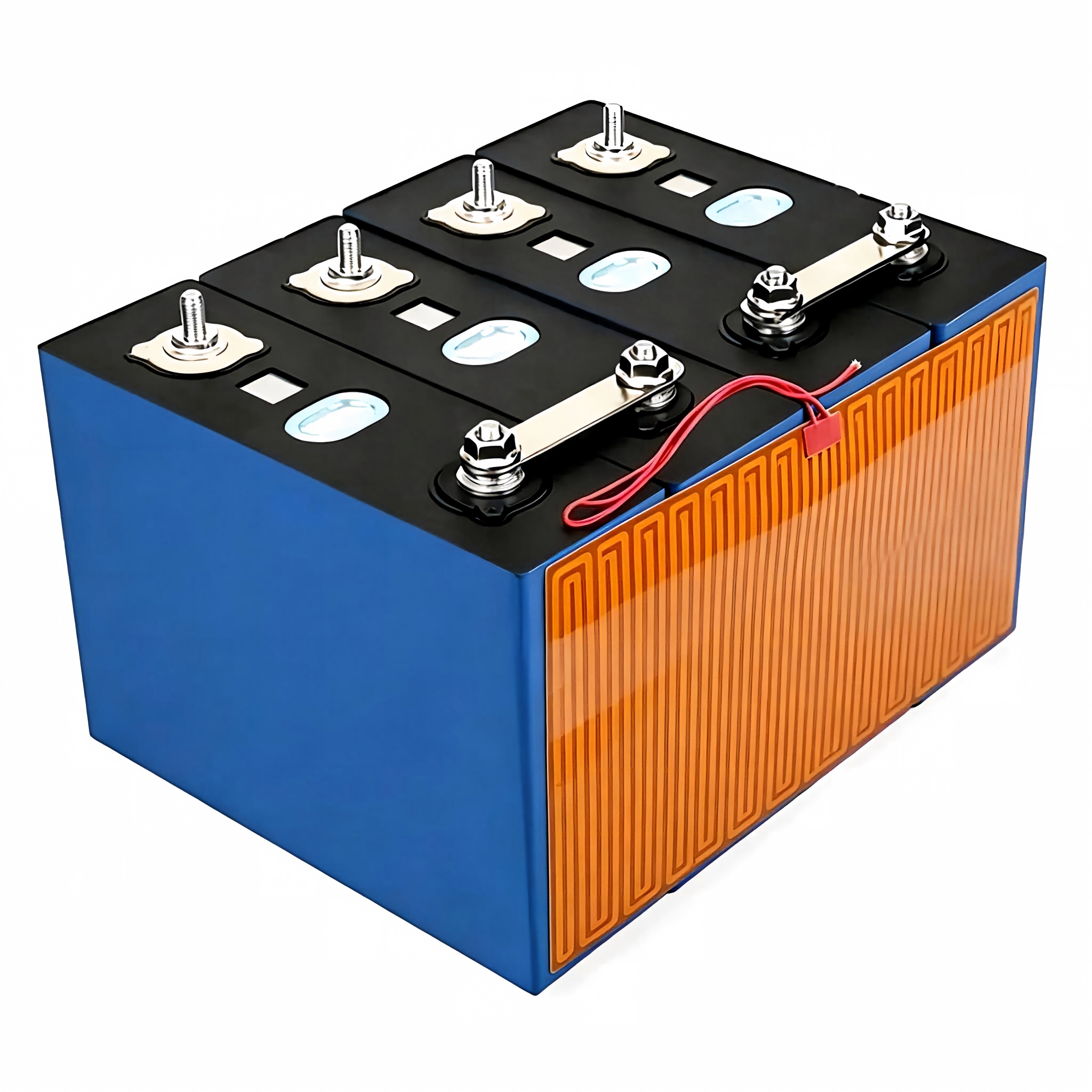
Polyimide vs Silicone Flex Heaters for Lithium-Ion Battery Packs
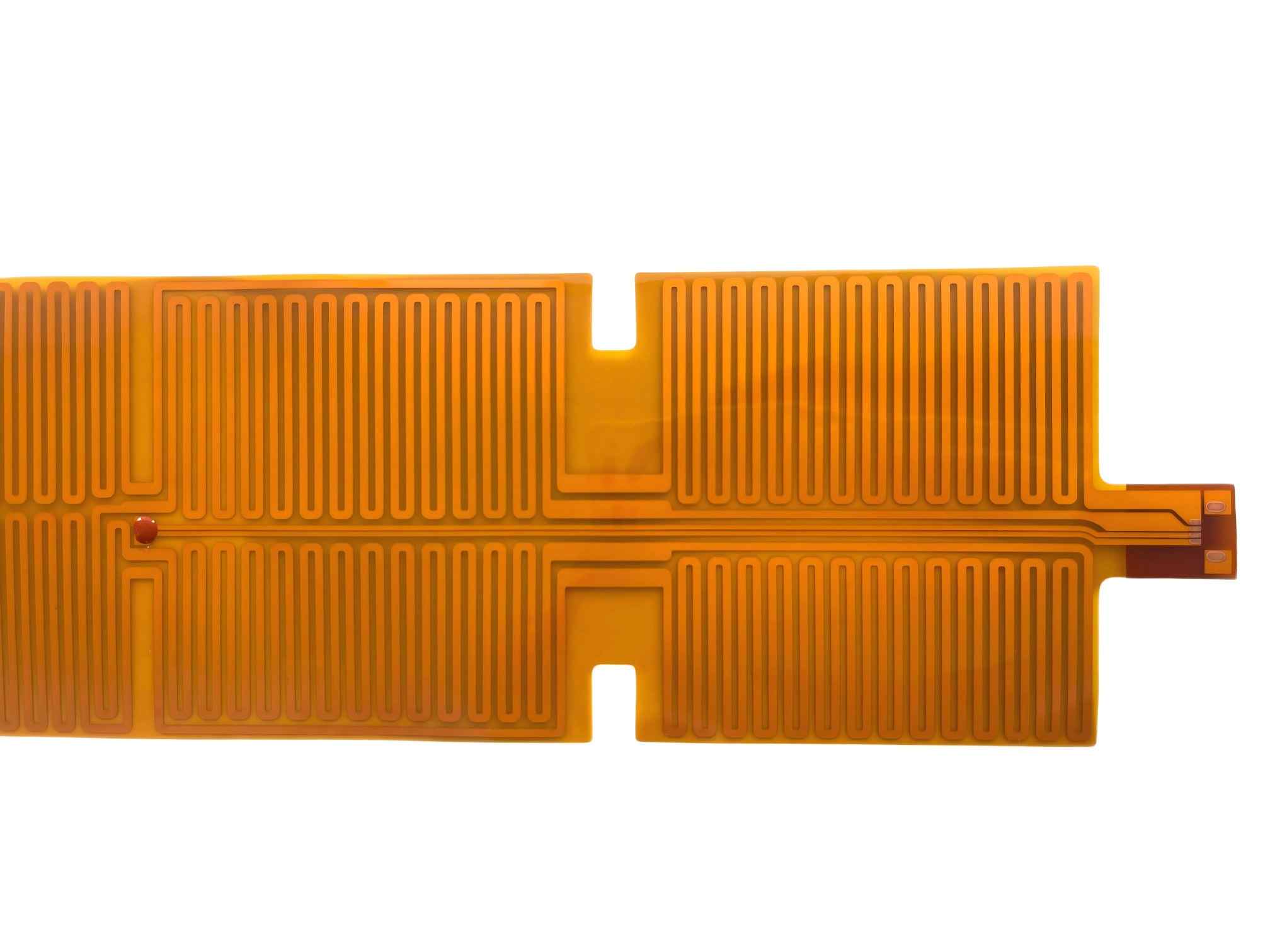
Can a Battery Heater NTC Measure Battery Cell Temperature?
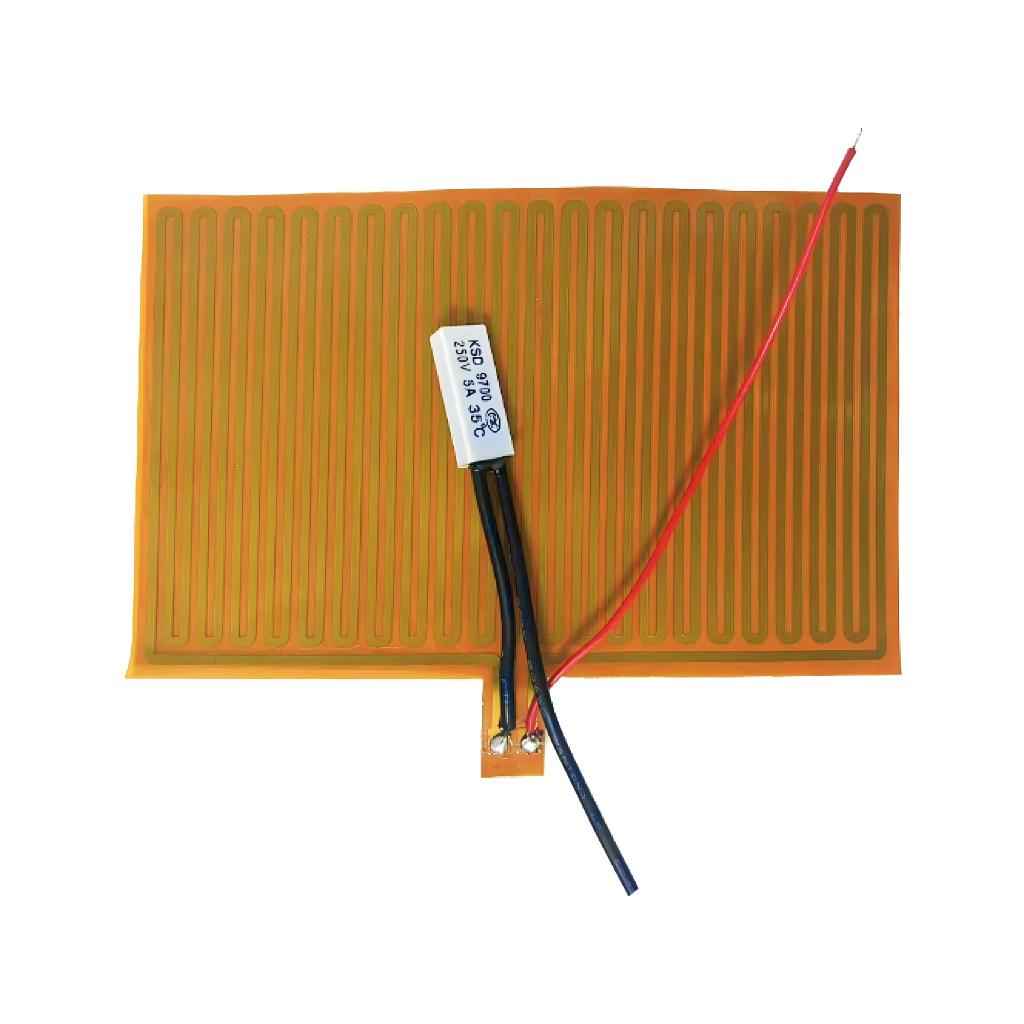
How to Integrate NTC Sensors and Thermal Protection Devices into Flexible Heaters?
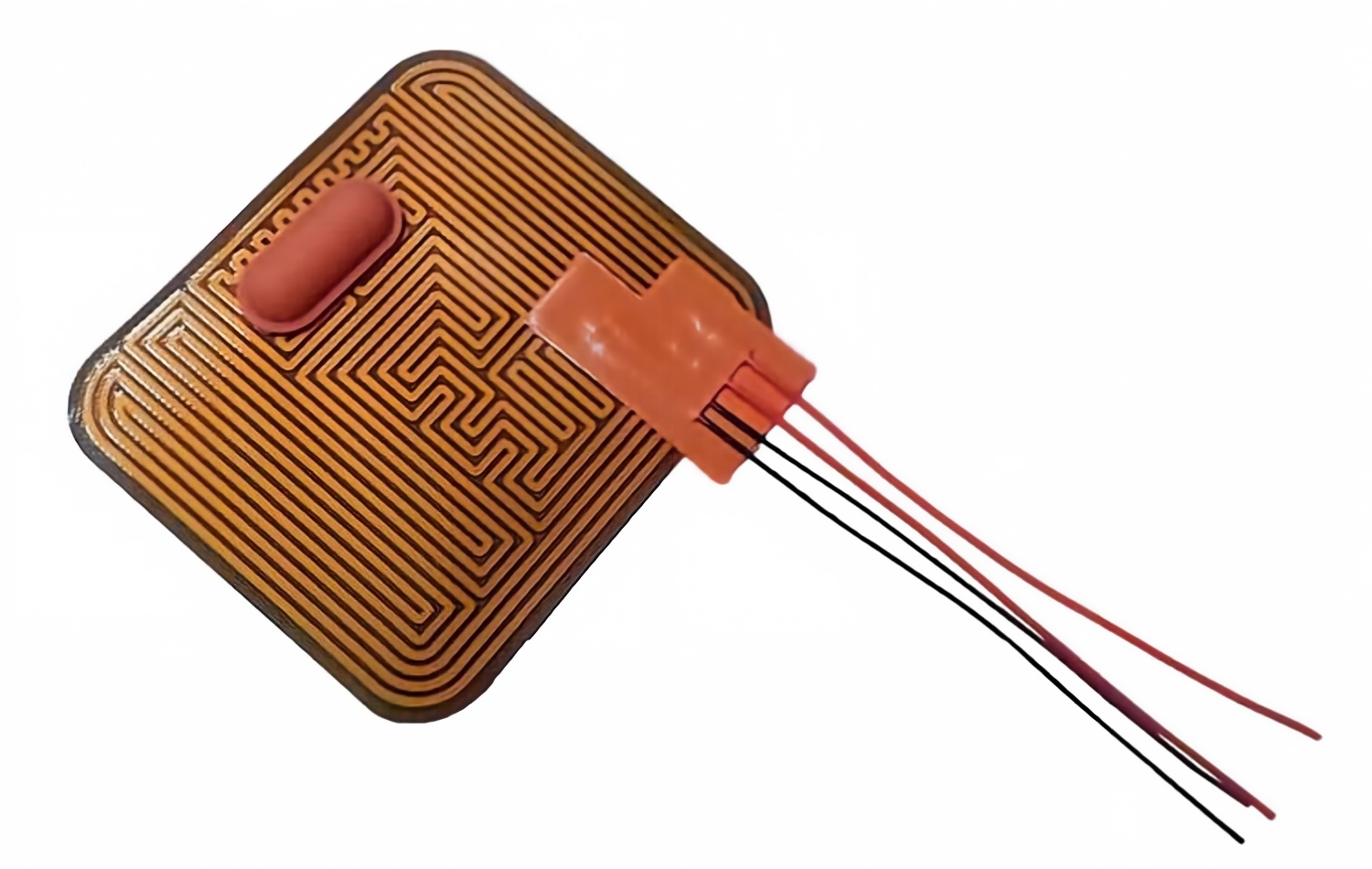
How Flexible Thin Film Heaters Improve Precision Thermal Control in Medical Devices?
Cartridge Heaters Complete Guide for Industrial Heating Applications
Temperature control and safety protection are critical considerations in modern heating applications. Whether used in battery thermal management systems, medical devices, semiconductor equipment, or industrial automation, flexible heaters require accurate temperature monitoring and reliable overheating protection.
To achieve precise thermal control, NTC thermistors, thermal fuses, and thermostats are commonly integrated into heater designs. Depending on the application requirements, these components can be either integrated into the heater circuit structure or installed externally.
This article explains different integration methods and how to select the most suitable temperature control solution for custom flexible heaters.
An NTC thermistor is a temperature sensor whose resistance decreases as temperature increases.
Unlike thermal protection devices, an NTC does not directly interrupt the power supply. Instead, it provides real-time temperature feedback to an external control system, such as a thermostat controller, battery management system (BMS), or microcontroller.
By monitoring resistance changes, the control system can accurately regulate heater output and maintain the desired temperature.
Advantages of NTC integration:
● Precise temperature measurement ● Closed-loop temperature control ● Adjustable temperature settings through software ● Suitable for applications requiring high temperature accuracy
Typical applications include:
● Battery heating systems ● Medical diagnostic equipment ● Laboratory instruments ● Semiconductor equipment ● Precision thermal management systems
For applications requiring a clean and compact design, the NTC thermistor can be integrated directly into the heater structure.
The heater circuit can be designed with:
● Reserved SMD pads on the etched heating circuit layer
● Dedicated NTC traces extending to wire terminals
● External wires connected directly to the customer’s control system
Design characteristics:
The NTC sensor can be positioned at any required location on the heater surface according to the thermal distribution requirement.
This solution provides:
● Thin overall structure
● Improved mechanical integration
● Accurate temperature feedback at the heating surface
● Reduced assembly process
This design is especially suitable for applications with strict space limitations, such as:
● Lithium battery pack heaters
● Wearable heating devices
● Compact electronic equipment
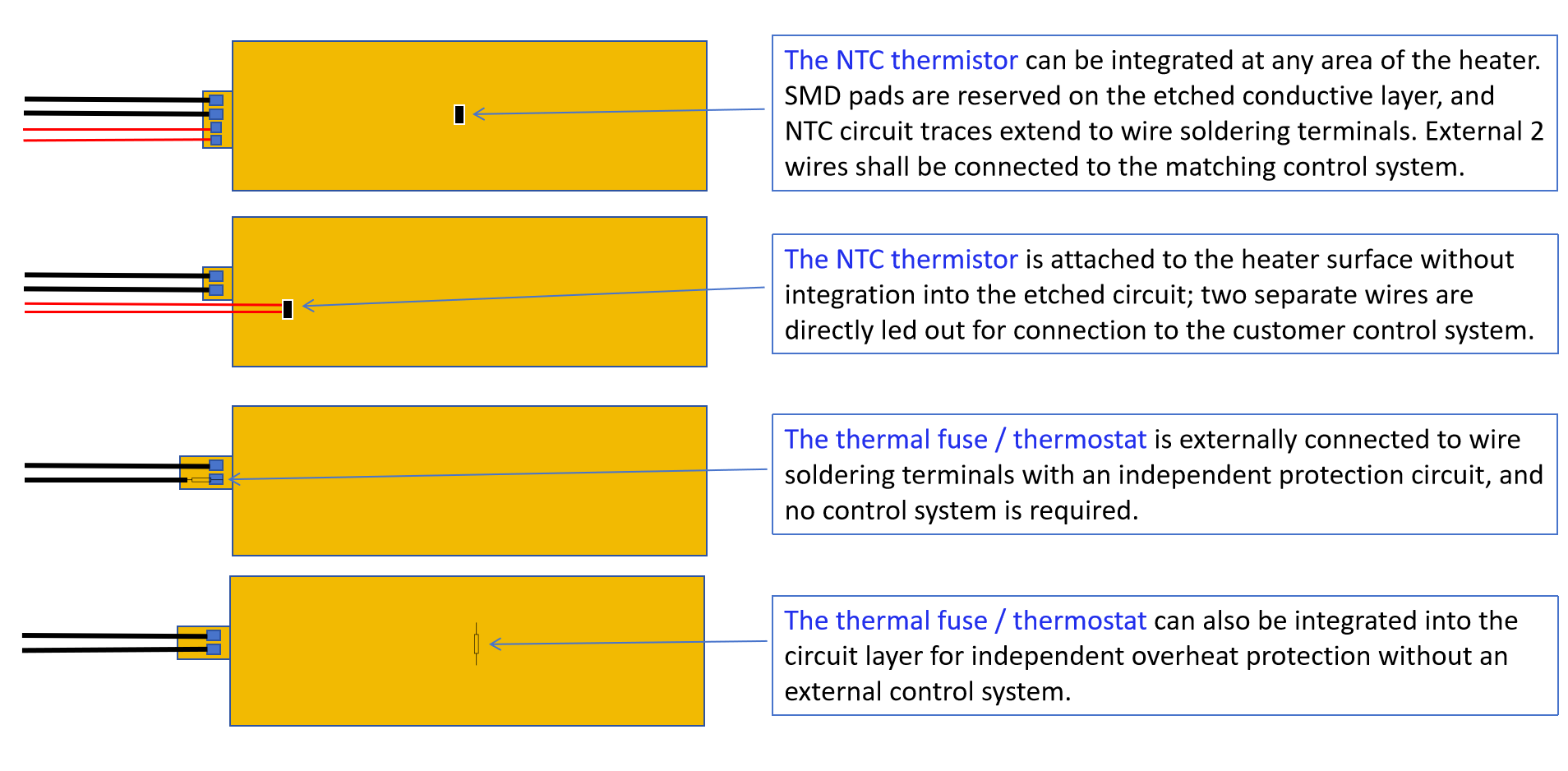
Another common solution is attaching the NTC thermistor directly onto the heater surface without integrating it into the etched circuit layer.
The sensor is connected through two independent wires and communicates with the customer's temperature controller.
Advantages:
● Simple design modification ● Lower tooling requirements ● Easy replacement and maintenance ● Flexible sensor positioning during testing
This method is often preferred during the prototype stage because customers can evaluate different sensor positions before finalizing the mass-production design.
Unlike an NTC sensor, a thermal fuse or thermostat provides hardware-based protection without requiring an external control system.
These components operate independently and automatically respond when the temperature exceeds the preset limit.
Thermal Fuse
A thermal fuse is a one-time protection device. When the temperature exceeds the rated activation temperature, the internal connection permanently opens and disconnects the heater power supply.
Advantages:
● Independent safety protection ● No software control required ● Reliable fail-safe operation ● Suitable for safety-critical applications
Typical applications:
● Battery heaters ● Home appliances ● Industrial equipment ● Automotive components
Thermostat / Thermal Switch
A thermostat is a resettable thermal protection device. When overheating occurs, the thermostat disconnects the circuit. After the temperature decreases to a safe level, it can automatically reconnect depending on the switch type.
Advantages:
● Reusable protection ● Simple electrical connection ● No additional control electronics required
Similar to NTC solutions, thermal protection devices can also be integrated in different ways.
Method 1: External Connection to Heater Wires
The thermal fuse or thermostat is connected externally to the heater power wires. The protection device forms an independent safety circuit.
Benefits:
● Easy assembly ● Easy replacement ● Suitable for standard heater designs
Method 2: Integrated into the Heater Circuit Layer
For highly customized heaters, the thermal protection component can be integrated directly into the circuit layer.
This provides:
● Compact structure ● Reduced external wiring ● Improved assembly efficiency
The heater can achieve independent overheating protection without relying on an external controller.
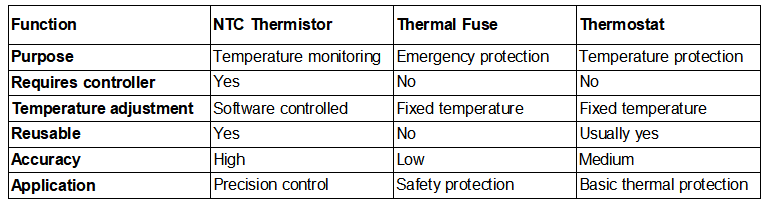
For many high-value applications, the best solution is not choosing between NTC and thermal protection, but combining them.
A typical design:
1. NTC sensor → monitors temperature and controls heating performance
2. Thermal fuse / thermostat → provides independent hardware safety protection
This dual-protection approach ensures:
1. Accurate temperature regulation during normal operation
2. Reliable shutdown protection under abnormal conditions
For example, in battery heating systems:
1. NTC maintains the battery within the optimal charging temperature range
2. Thermal fuse prevents overheating caused by control system failure
The integration method of temperature sensors and protection devices plays an important role in flexible heater performance, safety, and reliability.
Depending on application requirements, NTC thermistors can provide accurate temperature feedback, while thermal fuses and thermostats offer independent overheating protection.
With customized circuit design, flexible heaters can integrate these components directly into the heater structure or use external mounting solutions to meet different application requirements.
At HRX Heaters, we support customized flexible heater designs with integrated NTC sensors, thermal fuses, thermostats, connectors, and multi-zone heating circuits to provide optimized thermal solutions for industrial, battery, medical, and elec.
We offer a wide variety of high-efficiency heaters and heating element.Such as polyimide/kapton heaters,silicone rubber heaters,PET transparent heaters, thick film heaters,PTC heaters, mica heaters,epoxy resin heaters and graphene heating film.
 English
 Russian
 French
 Spanish
 German
 Polish